Frequently asked questions
Which vehicles will be used in the trials?
The vehicles used in each of the three trials will be 100% battery powered electric vehicles (BEVs). The exact make and model for the vehicles implemented in the home-charging and depot-charging studies will be selected by the appropriate trials partner and announced in the ‘News’ section. The BEVs implemented in the mixed-charging trial will be dependent on driver selection, and will be reported at 6-monthly intervals throughout the project.

What is a ‘profiled connection agreement’?
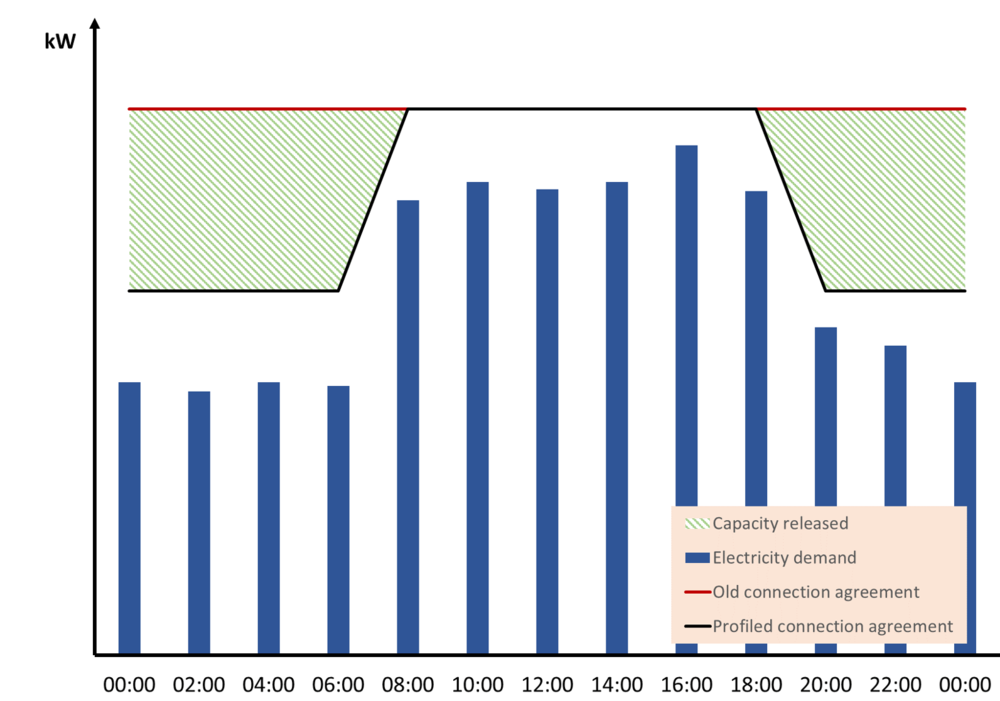
A profiled connection agreement is a new way for DNOs to allocate capacity to their commercial customers. In such an agreement, the connecting customer is given a maximum electricity demand ‘profile’. This means that the amount of capacity that the customer is allocated changes over the day to meet their electricity consumption needs. A time-variable connection agreement is a new concept - previously capacity has been allocated by using the maximum consumption from the site as a basis for the connection agreement amount. Profiled connections hold benefits for both the network and the connecting customer:
The network can allocate the capacity released (see diagram) to other customers making for more efficient use of the network
The connecting customer benefits from reduces connection costs as (over the course of the day) they are taking up less space on the network
The use of smart-charging to adhere to profiled connections will be explored in the depot charging trial at Royal Mail depots.
What are ‘flexibility services’ and how are they valuable to the network?
Flexibility services (or just ‘flexibility’) are procured by DNOs to alleviate network constraints. In a flexibility contract, connected consumers/generators can turn-up/down the electricity they demand/supply to the network when ordered to by the DNO. The DNO then rewards this action with a payment. In the context of Optimise Prime we will be considering two types of flexibility, both achieved through the use of smart charging:
Profiled connections - these connection agreements are a way for DNOs to procure flexibility ‘up-front’
Demand response - the smart chargers deployed in both home-charging and depot-charging trials will be used to turn up/down the electricity demand from the EVs
Flexibility is valuable for DNOs as promotes a more efficient use of the network, and can be used to defer costly network upgrades.
What is the timeline of the project?
The project runs from January 2019 - February 2022
How is Optimise Prime unique?
Optimise Prime is the first project to specifically address the network challenges of commercial EVs. Commercial vehicles have different operational requirements to domestic vehicles, hence the move to electric will pose different challenges and requires specific investigation. The aggregation of learning across the three trials will give good coverage over commercial vehicles, and once combined with the outcomes of numerous domestic EV studies DNOs will have access to far improved understanding of the majority of EV behaviour.
Within the project, smart charging and metering will allow ‘self-service’ determination of load profiles by connecting customers to develop a profiled network agreement, optimising both site and network capacity. In addition to this, Optimise Prime will employ a Hitachi Pentaho platform in combination with advanced machine learning techniques to manage and analyse a large volume of data from EVs and chargers. The processing of such quantities of data will allow for the development of sophisticated predictive models, mapping charging behaviour all the way through to network effects.
How is Optimise Prime beneficial to the public?
By testing ‘profiled connections’, ‘smart charging’ and ‘flexibility services’ we will understand how we can reduce the impact of EVs on the network. This will enable investment to be deferred and existing infrastructure to be used better which will reduce the costs of network reinforcement which, in turn, will keep electricity bills lower, and allow the transition to EVs to be made more quickly